
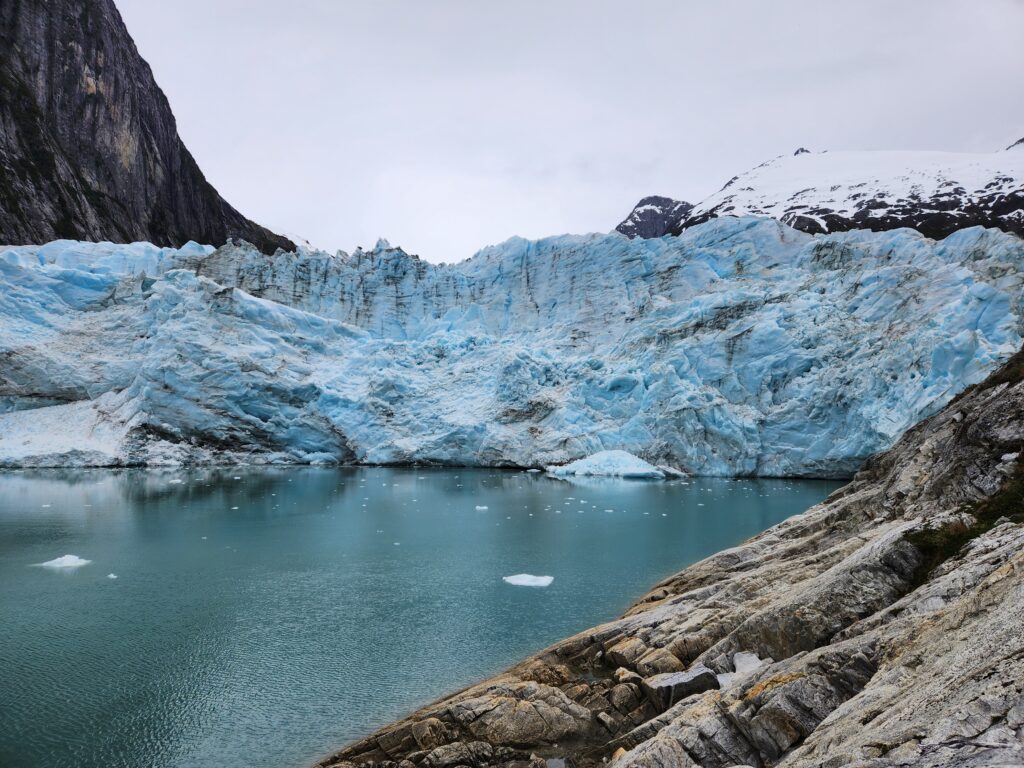
Why Patagonian Ice Is Blue
Why Patagonian Ice Is Blue And what it means that it’s disappearing. There is a moment, navigating the fjords of the Southern Ice Field, when the world loses the colors you knew. The sky is grey. The water is dark green. And the ice that ice you expected to be white, that postcard ice is blue. Not just any blue. A deep blue, almost violet in the deepest crevasses. A blue that does not look natural. A blue that looks manufactured. It is not. It is 10,000 years old. Time Converted Into Color The ice of the Patagonian glaciers did not fall yesterday. It accumulated over millennia, layer upon layer of compressed snow, until the weight eliminated almost all the air trapped between the crystals. Air is what makes ordinary ice white. When you remove it when time and pressure do their work over thousands of years the ice absorbs the red and yellow wavelengths of light and reflects only the blue. What you see when you look at a Patagonian glacier is not a color. It is time. It is a decade before writing existed. It is an era before there were cities. It is the planet functioning without us. The blue of the ice is the visual proof that something is ten thousand years old. What the Ice Remembers Inside that blue ice there are trapped air bubbles tiny capsules of ancient atmosphere. Scientists drill into them, extract them, and analyze them. What they find inside is the exact composition of the planet’s air from 10,000, 50,000, 200,000 years ago. The ice is a memory. It remembers volcanic eruptions. It remembers periods of extreme cold. It remembers CO2 concentrations before industrialization. And it remembers with a precision no human archive can match exactly how much we have changed the planet in the last 200 years. When you navigate in front of Glaciar Amalia or Glaciar Bernal, you are not looking at a landscape. You are reading an archive. The Blue That Is Leaving Glaciar Amalia one of the most accessible on the Ruta Kawésqar has retreated more than 800 meters in the last decade. Glaciar Guillard, where the Skorpios III makes its first stop, loses mass every season. Scientists call this “glacial retreat.” It is a technical phrase for a simple fact: the ice that took 10,000 years to form is melting in decades. The blue you see today, in that remote fjord 505 miles from Puerto Natales, is a blue your children may never see. This is not alarmism. It is what the data say. It is what the glaciers say. Why It Matters to See It Now Some experiences have an expiration date. Traveling to the Southern Ice Field in 2026 is not the same as it was in 1990. And it will not be the same in 2040. Each season that passes, the landscape changes. Glacier fronts retreat. Bays open where ice once stood. We do not say this to manufacture urgency. We say it because it is true. The travelers navigating the Ruta Kawésqar today are seeing something that few humans in history have seen, and that fewer and fewer humans in the future will be able to see. The blue of the ice is one of the rarest colors on the planet. And also one of the most fragile. What Changes When You See It Something happens when you stand in front of a glacier and someone explains all of this. When you understand that that blue is time. That those crevasses contain air from ten millennia ago. That the cracking sound you hear is the ice releasing bubbles of an atmosphere that no longer exists. The landscape stops being decorative. It becomes something that questions you. That asks you things. About time. About permanence. About what we leave behind and what we destroy. That is what separates seeing a glacier from understanding a glacier. And that difference between seeing and understanding is exactly what we try to design into every expedition. Patagonia, From the Inside. The Ruta Kawésqar departs from Puerto Natales between October and April. Glaciar Amalia and Glaciar Bernal are part of the standard Skorpios III itinerary. What are you passing on to those who come after?